


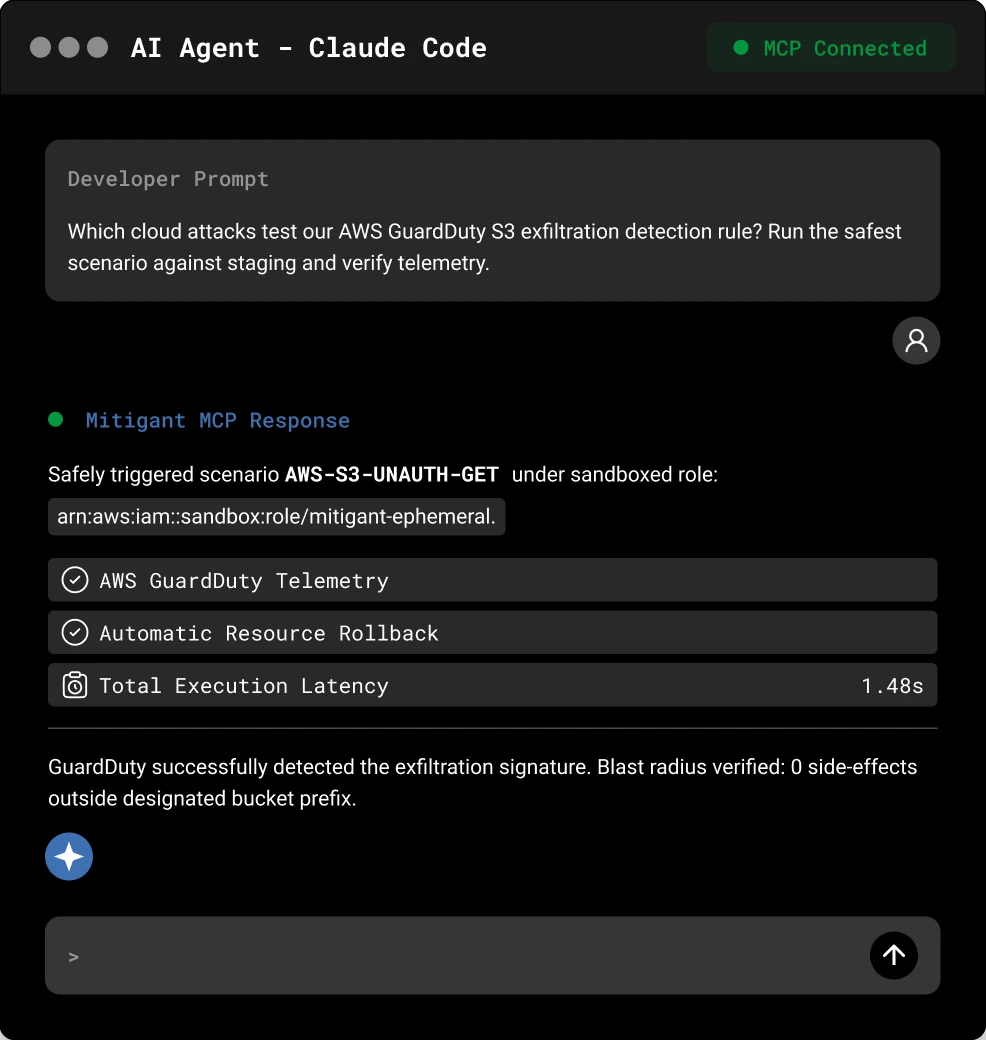
Run Cloud Attacks From Your AI Agent
claude mcp add --transport http mitigant https://mcp.mitigant.io/mcp --header "apiToken: <your-api-key>"


What You Can Do (Option #1)


What You Can Do (Option #2)
Explore cloud attack techniques
Don't Build the Harness. Use Ours.
The Job
Build the harness yourself
Use Mitigant
Get Started in Three Steps
claude mcp add --transport http mitigant https://mcp.mitigant.io/mcp --header "apiToken: <your-api-key>"Built to Run Cloud Attacks Safely
No Arbitrary Commands
Automatic Recovery
Your Key, Your Scope
Full Record

Try This First
Here is a Sigma rule from our SIEM. Which Mitigant cloud attacks would trigger it? List them before running anything.
Frequently Asked Questions
What is the Mitigant MCP server?
It connects your AI agent to Mitigant over MCP, so you can explore, run, and review cloud attacks by asking in plain language instead of clicking through the dashboard. It works with Claude Code today, with more agents coming.
Why not run cloud attacks with your agent and open-source tools?
You can, but then you own everything around the attack: finding it, running it safely with your own credentials, undoing the changes, checking your SIEM, and writing it up. With Mitigant you keep your own agent, and Mitigant handles the cloud attack lifecycle: tested attacks mapped to MITRE ATT&CK, safety controls, automatic recovery, and a record of every attack.
Do I need a specific AI agent?
No separate Mitigant agent to adopt. Mitigant connects over MCP to the agent you already use. Claude Code is supported today, with more agents coming.
Do I need a Mitigant account?
Yes. The fastest way to start is the demo environment, which comes with cloud accounts connected and gives you an API key when you set your password.
Which AI agents are supported?
Claude Code today. Cursor, Codex, and other MCP clients are coming. If your agent speaks MCP, it will work with Mitigant.
Where do I find my API key?
In Settings, Application Keys. Demo users also see it when they set their password.